
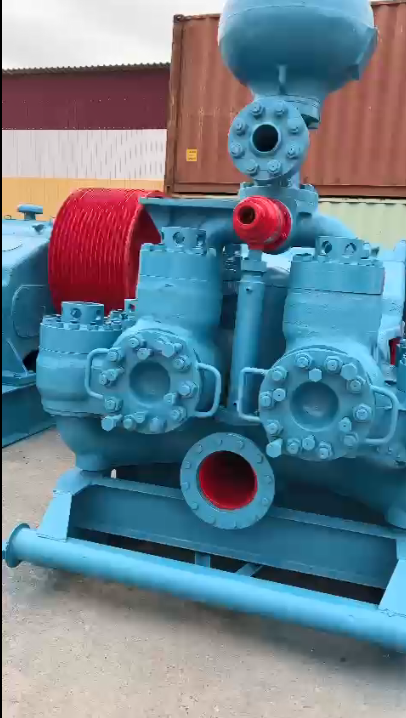
The drilling pump UNB-600/A is designed to supply flushing fluid to the bottom when drilling wells up to 5000 m deep,
for driving a turbo drill and removing drilling fines.
The UNB-600A pump is distinguished by high operational reliability due to:
– presence of a forced lubrication system for rods;
– use of two-chamber floating rod seals;
– use of a new safety valve design.
Power – 600 kW, productivity m³/h (hp) – 71-185 (20-52), discharge pressure MPa – 25-10, inlet pressure MPa – 0.02, overall dimensions (LxWxH), m: 5.3 x 3 x 3.3, weight (without pulley and compensator) t.: 23.95
The drilling pump UNB 600 (U86MA2) is designed to supply flushing fluid to the bottom when drilling wells up to 5000 m deep.
During rotary drilling, the UNB 600 pump supplies flushing fluid through a string of drill pipes to the bottom of wells for cooling and removal of rock destroyed by the bit, as well as for transferring flow energy to the turbodrill and the associated bit. Water or a clay solution containing oil, alkali, soda and other components is used as a washing liquid.
UNB-600 is a horizontal mud pump with a nominal power of 600 kilowatts. It is widely used in the oil and gas industry for exploratory drilling, maintenance and repair of wells to improve their efficiency.
The main purpose of this pump is to supply flushing fluid into the well, which cools the working parts of the drilling rig and helps remove destroyed rock from the wellbore. At the same time, it can also be used to power a turbine-type drill with flow energy.
This pump is considered quite powerful, so it is advisable to use it for deep wells up to 5000 meters.
Equipment
Like other similar units, the UNB-600 pump is a system of two blocks:
The hydraulic unit, which is directly responsible for pumping fluid through the pump housing.
A drive unit that creates and transmits mechanical movement from an electric motor to hydraulics.
The movement is transmitted through a crank mechanism, and both blocks are mounted on a single frame and constitute a single mechanism.